セミナーSeminars
2025-12-26
【セミナー】 グリーンファルマ研究所セミナー(深井真寿子先生、 深井透先生、 Vascular Biology Center, Medical college of Georgia at Augusta University)
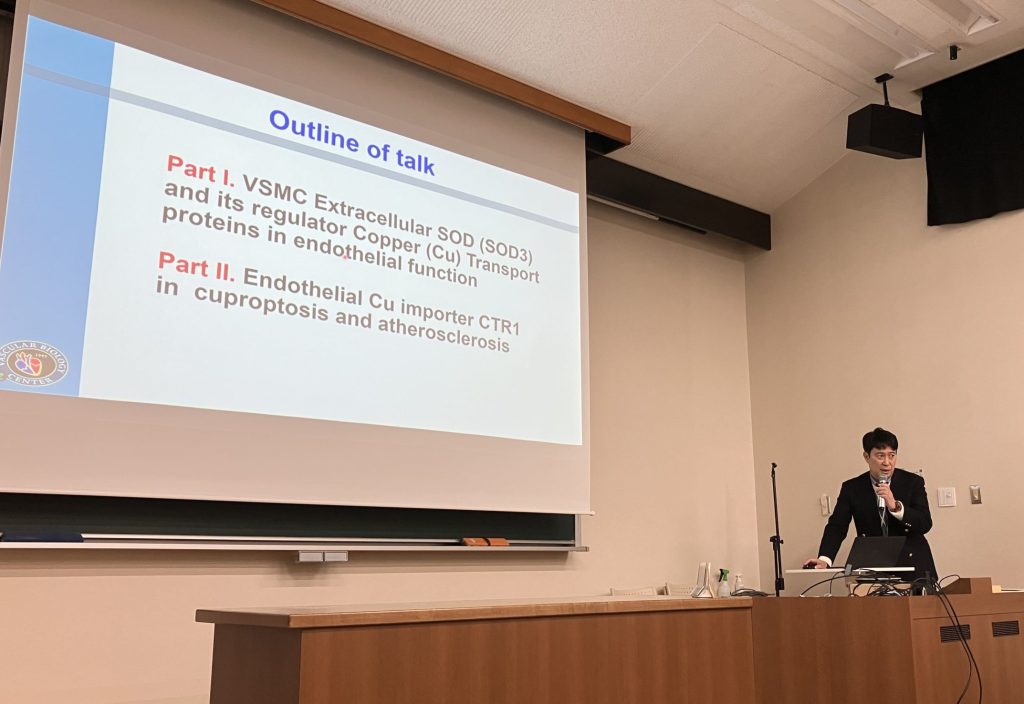
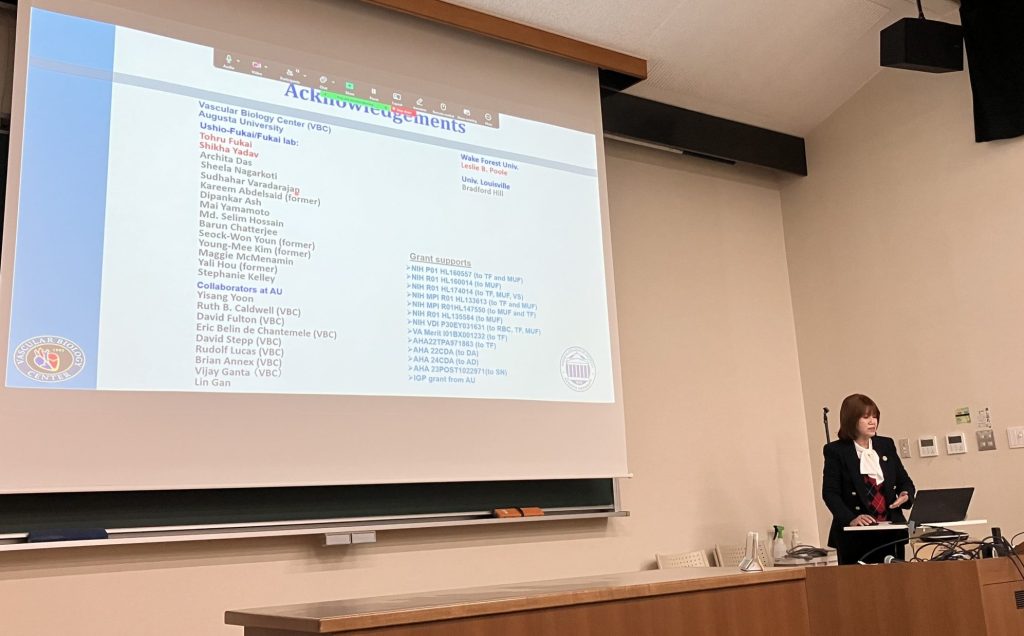
令和7年12月26日(金)午後5時よりオーガスタ大学の深井真寿子先生、深井透先生のセミナーを開催いたしました。
日 時:令和7年12月26日(金) 17:00~18:30
場 所:病院地区キャンパス 薬学部5階 第4講堂
タイトル: Copper Transport Proteins as Mediators of Redox/Metabolic Signaling and Cuproptosis in Vascular Disease
演 者:深井透(Tohru Fukai)先生(Vascular Biology Center, Medical college of Georgia at Augusta University, Professor)
要 旨:Copper (Cu) is an essential trace metal required for redox and metabolic homeostasis, functioning as a catalytic cofactor for mitochondrial respiration, antioxidant enzymes, and extracellular matrix remodeling. Tight control of intracellular Cu distribution is mediated by transport systems such as the uptake transporter CTR1, the exporter ATP7A, and the Cu chaperone Atox1. Loss of this balance results in oxidative stress, metabolic dysregulation, and inflammation, pathological features that underlie cardiovascular disease and cancer. Although Cu chelation has been shown to markedly suppress atherosclerosis in experimental models, the mechanisms through which Cu drives vascular pathology are only beginning to be defined. A recently recognized Cu-dependent cell death pathway “cuproptosis” is initiated by mitochondrial Cu overload. We find that atheroprone regions of the aorta in atherosclerotic mice exhibit elevated Cu content, and that disturbed hemodynamic shear induces CTR1-dependent Cu accumulation in both the cytosol and mitochondria of human endothelial cells. This endothelial Cu overload promotes cuproptosis, mitochondrial dysfunction, and vascular inflammation. Importantly, a mitochondria-targeted Cu-depleting nanoparticle restores mitochondrial function and decreases inflammation and lesion development in the partial carotid ligation model. These results identify Cu transport proteins as critical mediators linking disturbed flow to mitochondrial Cu metabolism and position cuproptosis as a central mechanism of endothelial dysfunction and atherosclerosis. Targeting mitochondrial Cu vulnerability represents a fundamentally new therapeutic strategy for vascular disease.
タイトル:Macrophage Mitochondrial Drp1 as a Redox Switch for Reparative Polarization, Metabolic Reprogramming and Vascular Repair
演 者:深井真寿子(Masuko Ushio-Fukai)先生 (Vascular Biology Center, Medical college of Georgia at Augusta University, Professor)
要 旨:Peripheral arterial disease (PAD) causes chronic ischemia, vascular insufficiency, and skeletal muscle degeneration, yet current pro-angiogenic therapies fail to restore tissue perfusion. Macrophages are now recognized as key regulators of neovascularization and muscle repair, but the mitochondrial mechanisms specifying their reparative phenotype during ischemia remain poorly defined. Mitochondrial dynamics, regulated by balance between fission and fusion, are linked to innate immune signaling and metabolic reprogramming, suggesting that mitochondria may function as upstream redox “decision nodes’’ that dictate macrophage polarization. Here we found that the mitochondrial fission GTPase Drp1 is activated during hindlimb ischemia by oxidative cysteine modification (sulfenylation). Myeloid-specific Drp1 knockout or bone marrow replacement with a redox-insensitive Drp1-Cys→Ala knock-in mutant markedly impaired reperfusion recovery, angiogenesis, and muscle regeneration while increasing a pro-inflammatory macrophage phenotype and preventing reparative polarization. Mechanistically, hypoxia–serum starvation in macrophage in vitro induced Drp1 sulfenylation and metabolic transition from glycolytic to oxidative programs required for vascular repair. These findings identify Drp1 cysteine oxidation as a previously unrecognized redox checkpoint linking mitochondrial dynamics to macrophage metabolic reprogramming and reparative neovascularization in PAD. This mechanism highlights mitochondria not only as bioenergetic organelles but also as redox-sensing hubs that govern immune repair responses and suggests Drp1 sulfenylation as a potential therapeutic target for ischemic disease.